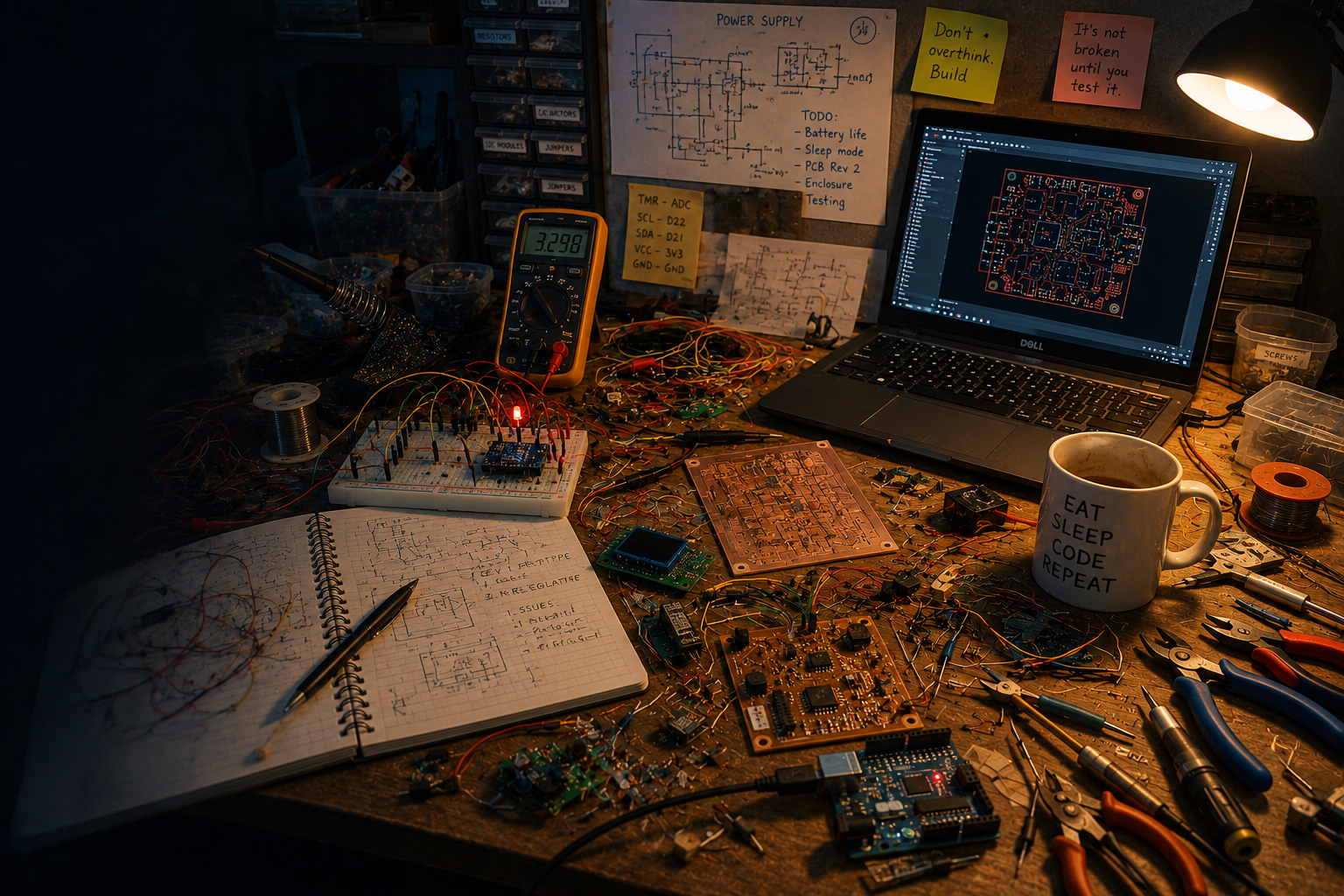
ENGINEERING GUIDE
DIY Hardware Development
What you can realistically build yourself, the challenges most people underestimate, and how to transition from prototype to deployable product.
What you can realistically build yourself, the challenges most people underestimate, and how to transition from prototype to deployable product.
Building electronics products has never been more accessible.
Development boards are inexpensive. PCB fabrication is available globally. Open-source software, online communities, and AI-assisted tools have made it possible for individuals to build surprisingly sophisticated devices.
Every year, founders, students, researchers, and engineers successfully create working prototypes from home laboratories, workshops, and small offices.
This has led many innovators to ask an important question:
Can I build my product myself?
In many cases, the answer is yes.
However, there is an important difference between building a prototype and building a product that can survive manufacturing, deployment, certification, and long-term field operation.
Twenty years ago, developing custom electronics often required access to specialized tools, expensive software, and significant capital.
Today, a motivated individual can access resources that were previously available only to large engineering organizations.
These advancements have dramatically reduced barriers to entry.
As a result, DIY development is often the fastest way to validate an idea, prove technical feasibility, and learn about the product itself.
Many successful products begin as DIY projects.
Depending on your experience, available time, and willingness to learn, it is entirely possible to independently develop:
Modern development tools allow individuals to move remarkably far before requiring external assistance.
A founder developing an agricultural monitoring device may successfully build an early prototype using development boards, commercially available sensors, and cloud connectivity services.
This prototype may be sufficient to validate customer interest, demonstrate functionality, and support early fundraising discussions.
Electronics development is rarely limited by technical knowledge alone.
The challenge is often the number of disciplines involved simultaneously.
A modern product may require knowledge of:
Most first-time developers discover that understanding one discipline is not enough. Success often depends on understanding how those disciplines interact with one another.
One of the most important lessons in hardware development is understanding the difference between a working prototype and a deployable product.
A prototype only needs to demonstrate functionality.
A product must continue operating reliably across hundreds, thousands, or even millions of operating hours while facing environmental, manufacturing, and user-related variations.
This distinction becomes increasingly important as a project moves from concept validation toward commercialization.
Once a concept has been validated, documenting requirements becomes increasingly important. Our guide to creating an Electronics Development Requirement (EDR) explains how engineering requirements are typically structured.
The engineering challenges associated with these objectives are often very different.
Consider a prototype that works perfectly on an engineer's desk.
That same design may encounter issues when exposed to:
Solving these problems often requires a completely different level of engineering effort than creating the initial prototype.
Most DIY projects do not fail because the concept is flawed.
They fail because certain engineering risks are not discovered until late in development.
Some of the most common challenges include:
Power systems influence nearly every aspect of product performance.
Battery life, thermal behaviour, operating stability, and reliability are often determined by decisions made during the earliest design stages.
A correct schematic does not automatically produce a reliable PCB.
Signal integrity, grounding strategies, EMI performance, and thermal management often depend heavily on layout quality.
Many projects begin with simple firmware requirements.
As products mature, features such as wireless updates, diagnostics, security, error handling, and data logging frequently increase software complexity far beyond initial expectations.
Components selected during prototyping may later become unavailable, obsolete, or difficult to source in production quantities.
Planning for sourcing flexibility becomes increasingly important as manufacturing approaches.
Manufacturing introduces challenges that are rarely visible during prototype development.
Assembly yield, process consistency, production testing, documentation, quality assurance, and inventory management all become important.
A design that performs well in small quantities may require significant refinement before it can be manufactured reliably at scale.
Many first-time developers are surprised by how much additional effort is required after a prototype works. If this sounds familiar, read: Why Hardware Development Feels Slow
A manually assembled prototype may tolerate component substitutions, wiring adjustments, and minor assembly inconsistencies.
Production environments require repeatable processes that produce consistent results across every unit manufactured.
This transition often surprises first-time product developers.
Many products eventually require regulatory approvals before deployment.
Depending on the application and target market, this may involve:
Compliance considerations often influence design decisions from the very beginning of a project.
Waiting until a product is complete can lead to expensive redesign cycles.
DIY development is an excellent way to learn, validate ideas, and build early prototypes.
However, there is often a point where the cost of solving increasingly specialized engineering challenges exceeds the value of continuing alone.
This transition point varies from project to project.
Some products reach it during PCB layout. Others reach it during manufacturing preparation, compliance testing, firmware scaling, or system integration.
Professional engineering support becomes particularly valuable when:
The objective is not to replace innovation.
It is to ensure that innovation survives the realities of deployment, production, and customer use.
As projects become more complex, founders often evaluate whether to continue independently, hire freelancers, or work with engineering firms. We explore these options in: AI vs Freelancer vs Engineering Firm
Successful founders rarely treat DIY development as an all-or-nothing decision.
Instead, they use DIY methods strategically.
They build enough to validate assumptions, understand the technology, gather market feedback, and reduce uncertainty.
Then they selectively bring in expertise when specialized knowledge creates greater value than continued experimentation.
The goal is to build a successful product in the most efficient, reliable, and commercially viable way possible.
There has never been a better time to build electronics products.
Development tools are more accessible than ever. Learning resources are abundant. Manufacturing services are available globally.
For innovators willing to invest time and effort, DIY hardware development remains one of the most rewarding ways to transform an idea into reality.
Just remember that every successful commercial product eventually becomes more than a prototype.
Understanding when to keep learning independently and when to leverage specialized expertise is often one of the most important engineering decisions a founder can make.
DIY development is an excellent way to validate ideas and build technical understanding, but commercial products eventually require consideration of manufacturing, compliance, reliability, and long-term support.
Whether you're developing your first prototype or preparing a design for manufacturing, our engineering team can help identify technical risks, review architectures, and accelerate development.
Discuss Your Project