ENGINEERING GUIDE
How to Write an Electronics Development Requirement (EDR)
A practical guide for founders, innovators, and product teams preparing to develop a custom electronic product.
A practical guide for founders, innovators, and product teams preparing to develop a custom electronic product.
We regularly speak with founders who have a great product idea but struggle to convert that idea into engineering requirements.
That is completely normal.
Most successful products are created by people who deeply understand a problem, an industry, or a customer need. They are not necessarily experts in embedded firmware, PCB layouts, power management, wireless protocols, or manufacturing processes.
Before any engineering work begins, there needs to be a document that bridges the gap between the business vision and the technical implementation. Many founders start with a prototype first. If that's your situation, you may also find our guide on DIY Hardware Development helpful before defining formal engineering requirements.
This document is commonly referred to as an Electronics Development Requirement, or EDR.
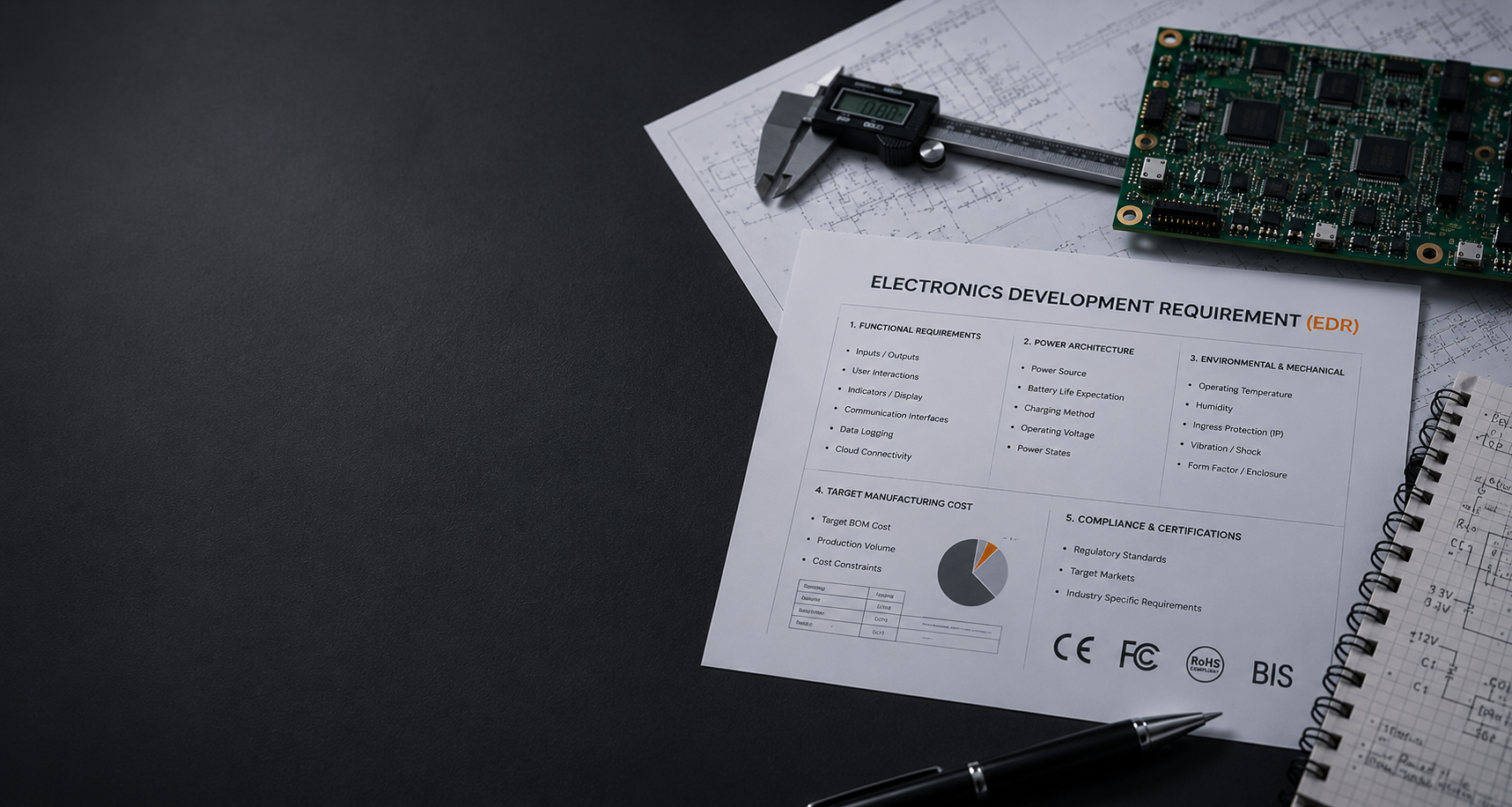
An Electronics Development Requirement is a structured document that defines what a product needs to do, how it will be used, and the constraints under which it must operate.
It does not need to be a highly technical document. In fact, some of the most useful EDRs are written by product owners using simple language that clearly describes expected behaviour and business objectives.
The better the information provided at the beginning of a project, the easier it becomes to make sound engineering decisions later.
Start by describing what the product must do.
Focus on behaviour rather than technology.
When the operator presses and holds the pairing button for three seconds, the device should enter pairing mode and flash a status LED until a connection is established.
This type of description is far more useful than simply stating that the product requires a Bluetooth module.
Include:
Power requirements influence almost every engineering decision in a product.
A battery-powered device designed to operate for several years requires a very different architecture than a continuously powered industrial controller.
Your EDR should answer:
One of the most common challenges we see is a mismatch between power expectations and product functionality.
For example, continuous cellular communication, GPS tracking, and large displays all consume significant energy. Understanding these trade-offs early helps avoid expensive redesigns later.
Electronics behave differently depending on where they are deployed.
A product designed for an office environment faces very different challenges than one operating inside industrial machinery, agricultural equipment, or defence vehicles.
Consider:
Environmental requirements often drive enclosure design, component selection, thermal management, and testing procedures.
Every successful product has a cost target.
Sharing your target manufacturing cost early allows engineering teams to make informed decisions about architecture, component selection, and performance trade-offs.
There is rarely a single correct technical solution. Good engineering is often about balancing performance, reliability, manufacturability, and cost.
Compliance requirements should be considered from the beginning of a development project, not after the prototype is completed.
Depending on the target market, you may need:
Designing with compliance in mind significantly reduces the risk of costly redesigns during certification testing.
Before submitting an EDR to a development partner, it is worth reviewing a few fundamental assumptions.
Addressing these questions early often eliminates major project risks before development begins.
Many product teams delay engineering discussions because they believe every technical detail must be fully defined first.
In reality, the opposite is usually true.
Early collaboration allows engineering teams to identify technical risks, challenge unrealistic assumptions, and recommend architectures that improve manufacturability and long-term reliability.
Your responsibility is understanding the problem. The engineering team's responsibility is translating that problem into a product that can be built, tested, certified, and manufactured reliably.
A well-written EDR significantly improves the likelihood of a successful project. For a broader discussion on the engineering practices that contribute to successful products, read The Foundations of Successful Hardware Development.
An Electronics Development Requirement (EDR) helps transform a product idea into clear engineering objectives, reducing ambiguity, technical risk, and costly redesigns later in development.
Whether you have a detailed specification or only an initial concept, our engineering team can help evaluate feasibility, identify technical risks, and create a practical development roadmap.
Discuss Your Project